The Troon Clubs:
The King Behind Their Creation
This page is best viewed on a larger screen.
This article was researched and written by Jeffery B. Ellis, author of And The Putter Went Ping; The Clubmakers Art: Antique Golf Clubs & Their History; and The Golf Club: The Good, The Beautiful & The Creative.
It is a supplement to “The Oldest Iron, The Troon Clubs, and Golf Club Evolution” also found on this site. That article contains additional detailed information and background information on the topic of the Troon clubs. This article will reference various sections between 1.1 and 2.7 in that report. For still more images and information on the Troon clubs, see The Clubmakers Art: Antique Golf Clubs and Their History, Second Edition, Volume 1 pages 25 through 29.
Copyright Jeffery B. Ellis 2024
1.1 Introduction
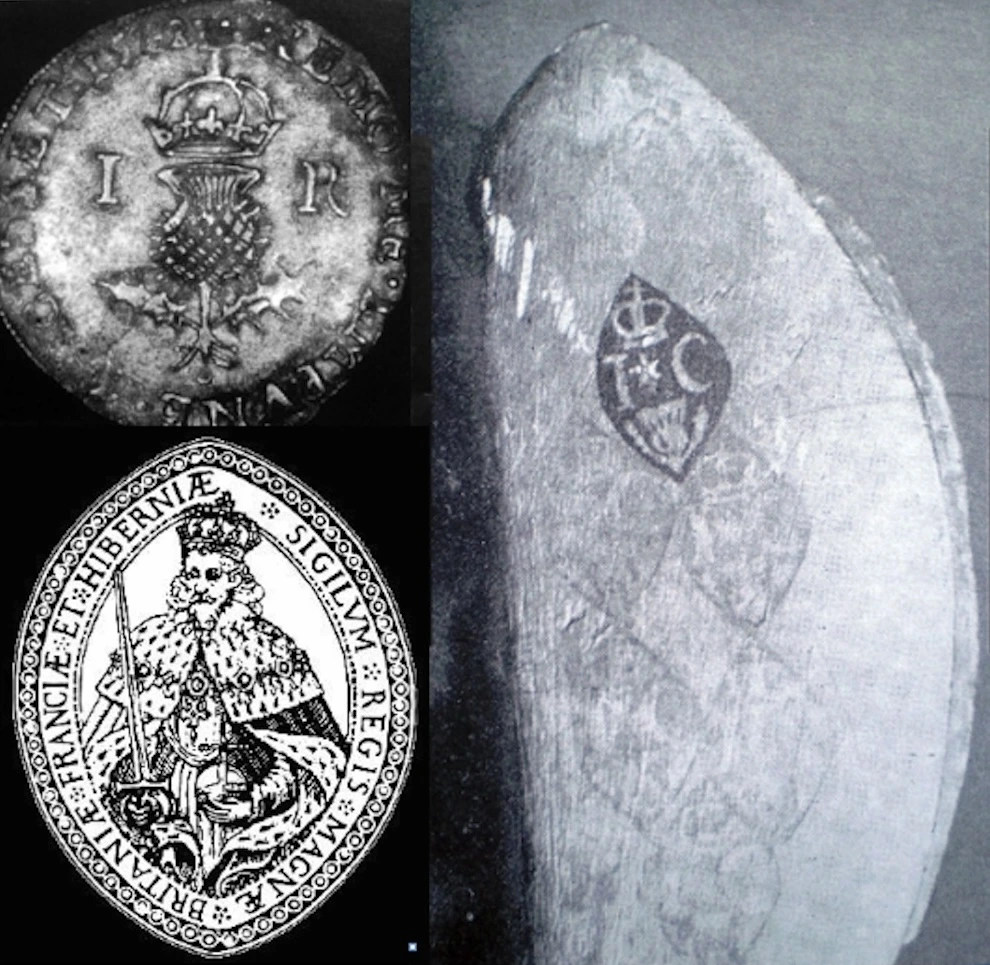
The eight Troon clubs, consisting of three pairs of woods (drivers and spoons) and two irons (a light iron and heavy iron), are shown below as they appeared in the August 26, 1898, issue of Golf shortly after they were discovered. The image of the club above is also from the 1898 issue, with the foremost stamp darkened by the magazine editor to make that mark more visible.
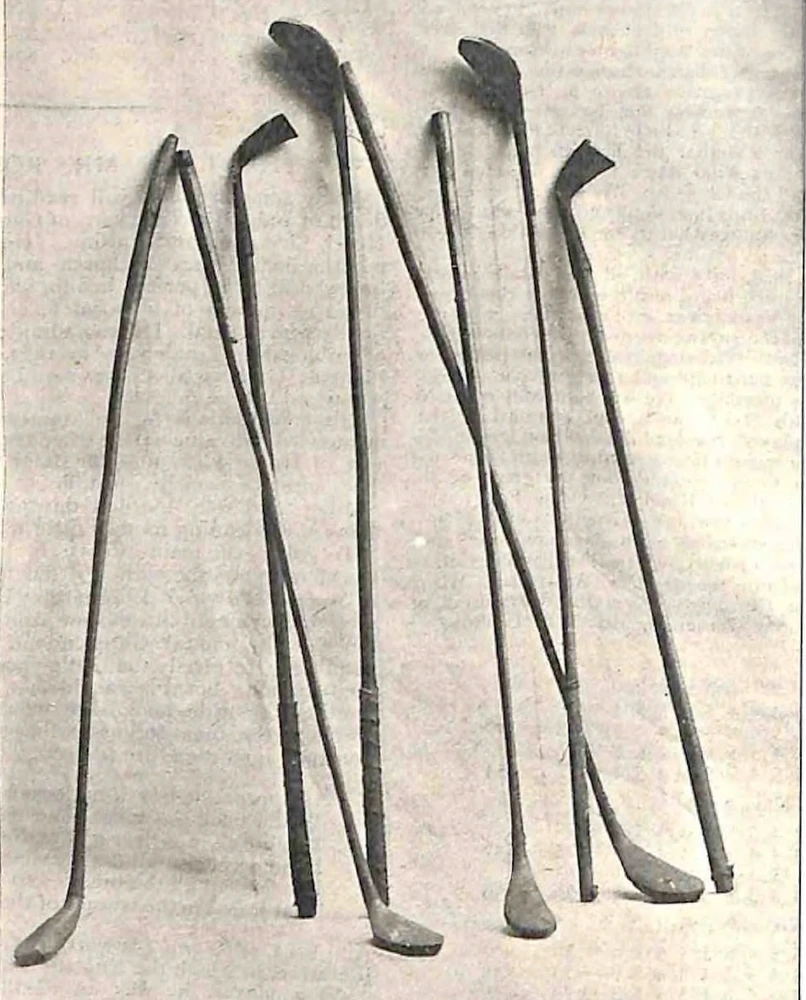
Ever since their discovery in 1898, the origin and age of these eight clubs have been subject to speculation. Widely believed to be the oldest set in existence, the Troon clubs have drawn significant attention, as has the stamp used to mark them. Featuring a crown, thistle, star, and the letters "I" and "C" inside a pointed oval, the stamp has remained an unsolved puzzle to the world of golf. As a result, it has been a topic of discussion for many years, with a focus on 17th- and 18th-century individuals linked to Scottish royalty whose initials share these same letters. These discussions have led to three main theories connecting the Troon stamp—and, by extension, the age of the clubs—to either:
- King James VI/I (reigned 1567-1625) and his son Prince Charles (born 1600) who later became King Charles I (reigned 1625-1649);
- James VIII (the rightful heir beginning in 1688 and claimant to the English crown) and his son Bonnie Prince Charlie (born 1720);
- James Carstairs, a clubmaker to Charles II (1660-1685).
This article will review the foundation of each theory, the supporting evidence, and the likelihood that the evidence accurately identifies the individual behind the stamp. A clear conclusion is reached. The key to documenting the age and origins of the Troon clubs lies in the stamp. It tells us everything, which is why it was used to mark these 8 clubs 44 times. Understanding the significance of this stamp, however, requires a fundamental knowledge of royal cyphers and insignia.
2.1 Royal Cyphers and Insignia are Absolute Identifiers ↩
Every monarch has had their own unique royal cypher and insignia, and variations thereof. These symbols are specifically designed to differentiate one monarch from the next, ensuring that no future ruler replicates the cypher or insignia of a predecessor. This tradition endures even today, as seen with the unveiling of King Charles III’s royal cypher in September 2022, which was met with great fanfare and public attention.
In its simplest form, a royal cypher consists of two stylized initials: the first is often the monarch’s Latin name, and the second is the monarch’s Latin title—'R' for Rex (King) or Regina (Queen). These initials are typically placed directly beneath or adjacent to a crown. Like other royal insignia, royal cyphers served as personal emblems of reigning monarchs, symbolizing their authority and presence on various items such as official documents, coins, uniforms, buildings, and more.
Royal insignia, which can include royal cyphers, coats of arms, and other heraldic symbols, often incorporate elements used by previous monarchs. However, these shared elements are frequently redesigned, resized, and rearranged to create a distinct insignia or cypher for each new monarch. As a result, while there may be shared symbols, the overall appearance will be distinctly different, much like a signature, distinguishing one monarch’s reign from another.
Royal insignia often reflect the monarch’s authority, lineage, or national identity. They can include crests, shields, or national emblems like the thistle (representing Scotland) or the lion rampant from the Scottish coat of arms. On Scottish coins they are simplified for practical use on smaller surfaces.
2.1a The Troon Stamp ↩
Each Troon wood has six identical stamps on its crown. The stamp contains the following symbols: a crown over a thistle bordered on each side by a letter/initial; a star is centered between the initials; a vesica piscis shape borders these marks. Below are some of the facts that connect to these symbols as arranged on the stamp.
- The layout of these symbols and the symbols themselves are distinctly similar to a royal insignia. The crown and two initials on the Troon stamp are arranged like a royal cypher, with the "R" typically found in a royal cypher replaced by a "C." Although the letters R and C under a crown do not fit the formal definition of a royal cypher as an identifier of the reigning monarch, this does not imply it lacked authorization from the monarch. It is a cypher in its own right. 1
- Royal cyphers and insignia were serious matters in Scotland and England during the 1600s. In Scotland, the Lord Lyon King of Arms—the official responsible for regulating heraldry, overseeing state ceremonies, and maintaining the Public Register of All Arms and Bearings in Scotland—had the authority to intervene and impose penalties if a royal cypher or insignia was used improperly without the monarch’s authorization. Such misuse could be considered fraud, and if it was perceived as challenging the monarch’s authority, it could even be classified as treason, leading to serious consequences enforced by the Court of the Lord Lyon. However, the creation of the royal cypher and insignia itself was the responsibility of the monarch, not the Lord Lyon.
- The heraldic star that separates the two initials can indicate succession in royalty, among other things. As Ian Crowe writes in the June 20, 2010 issue of Through the Green (pp. 42-43) “The Mullet or five-pointed star denotes some divine quality from above, celestial goodness, a noble person and, in cadency, is the mark of the third son. In heraldry, cadency is a system used to distinguish among members of the same family on coats of arms and, in the case of royalty, to show succession.” Crowe continues by documenting that Prince Charles to our knowledge has a 50/50 chance of being the third son of James VI/I. James had a stillborn child in July of 1595, 17 months after the birth of his first son, Henry Fredrick Stuart who died November 6, 1612. The sex of the stillborn was not recorded, but if the baby was male, James would have considered Charles his third son as well as his successor.
- The letters "I" and "C" are the initials of “Iacobus” and “Carolus,” the Latin forenames of James VI/I and his son Charles as well as James VIII and his son Bonnie Prince Charlie. These initials are also the full initials of James Carstairs, the clubmaker for King Charles II, as “I” was often used as a “J” in 17th-century Scotland. (See Addendum #2)
- The pointed oval shape forming the border of the stamp is a vesica piscis, not a diamond, as its sides are curved arcs and it lacks four corners. The vesica piscis, a symbol used in Christian art for over a thousand years before the reign of King James VI/I, represents the intersection of the divine and the human. The six stamps on each wood are laid out to recreate the shape of a vesica piscis. This repetition emphasizes/reinforces the vesica piscis used on the stamp (see 2.1d in The Oldest Iron for more on the vesica piscis).
- All of the Troon woods and irons bear marks from the same stamp, likely indicating that they were made at the same time, if not by the same maker. Given that it left an ink mark on the surface of the wood, the stamp itself was likely made from wood or possibly metal. As a result, the symbols do not display the same level of detail as those created by metal dies used to mint coins.
3.1 Theory 1: King James VI/I and Prince Charles ↩
The first theory identifies the “I” as the Latin initial of James VI/I and “C” is the Latin initial for Prince Charles. The heraldic star between the initials shows succession, and the vesica piscis shows James VI/I and Prince Charles had a special connection to God, which would be their belief in their divine right to the throne.
The evidence used to support this theory consists of (1) the insignia stamped 44 times on the clubs, (2) the vesica piscis that encloses the insignia stamped on the clubs, (3) the insignia of James VIII which does not match the Troon stamp (4) the visit of Charles I to Hull in 1639, and (5) the clubs themselves and other documented clubs.
3.1aInsignia, Cyphers & Coins ↩
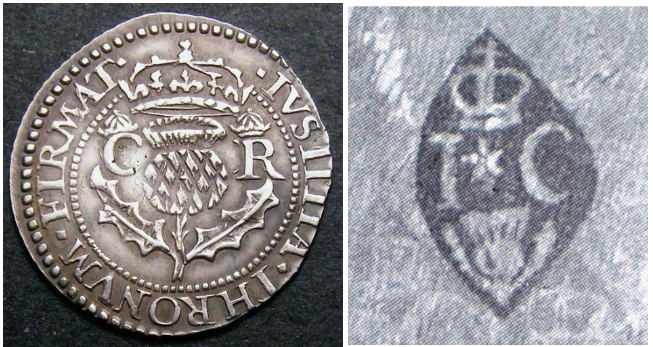
As shown at the top of this article, the royal insignia—a crowned thistle bordered by the two initials of a royal cypher—on the 1582 James VI/I coin shares clear similarities with the symbols and their layout on the Troon clubs. Coins were a common medium through which kings displayed their cyphers and insignia, as they were widely circulated and reached a broad audience. My coin search included both internet sources and Ian H. Stewart’s book The Scottish Coinage, published in 1955. While not exhaustive, this search provided significant information.
The designs on a monarch's coins often evolved, driven by factors such as economic demands (recoinage was a significant source of revenue), political events, technological advancements, and efforts to combat counterfeiting. Despite these changes, the royal insignia on the coins remained distinctive enough to ensure the monarch could still be clearly identified.
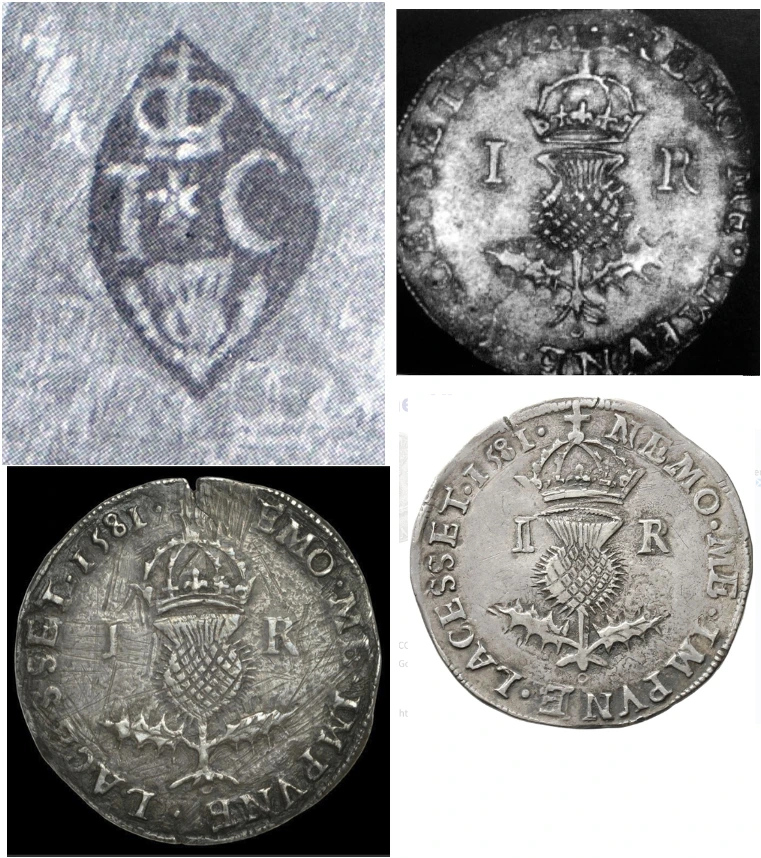
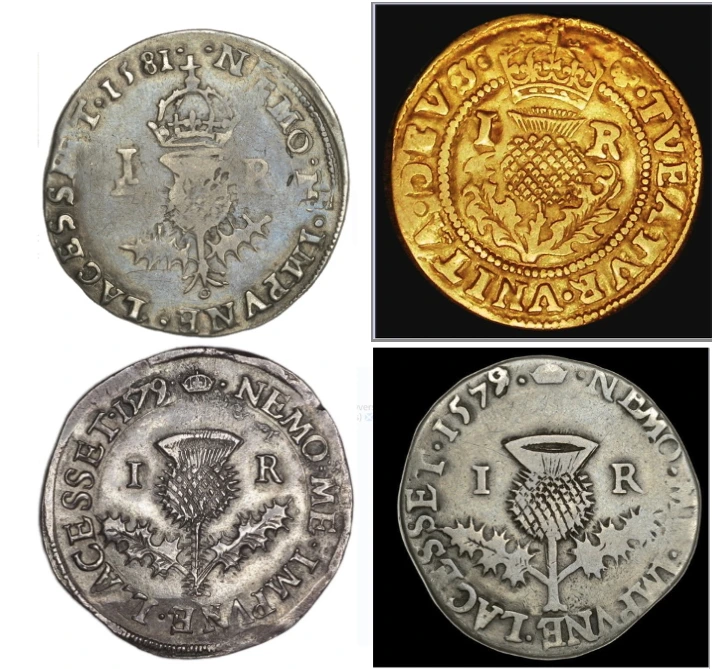
A comparison of coins issued by James VI/I through James VIII (plus a few others) follows. The Troon stamp is shown next to the coins of the various kings to demonstrate how the strong similarities between the stamp and the insignia on the King James VI/I coins are not found on the coins of any of the other kings. Each of the additional kings used their own cyphers and insignia to identify themselves, not those of King James VI/I.
James VI/I Coins: Below is the Troon stamp and seven different James VI/I coins with royal insignia that consists of a crown above a thistle bordered by two initials, albeit the bottom two coins have small crowns near their respective tops. The gold coin was produced after the union of the crowns when King James VI of Scotland became King James I of England in 1603. These coins are the James VI/I coins I found that come the closest to matching the Troon stamp.
Charles I Coin: Charles I, as his title acknowledges, was the first Scottish King Charles. He continued in the vein of his father, sometimes supplementing his royal cypher with a thistle. However, he changed the design of both the crown and thistle, as shown on the coin below. Because he was the first Scottish king to use the initial C in his cypher, the C alone made the entire cypher recognizable as that of Charles I. Nevertheless, a small crown was installed above each initial, to help make his cypher unlike any other.
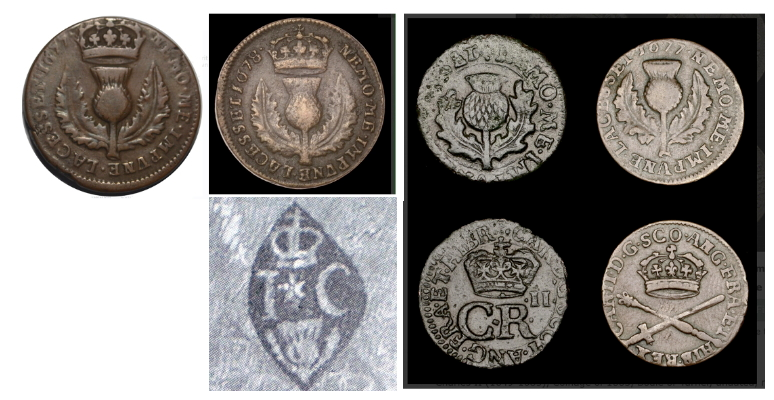
Charles II coins (James Carstairs, clubmaker): As shown on the six coins below, when Charles II became king he changed the layout of his cypher, the design of the crown, and included the Roman numeral II. When he used a thistle he changed its design as well, to help make his insignia unique.
I was unable to locate any Charles II coins that included a crowned thistle and two initials. However, I did find a few that have a crowned thistle similar to that found on the two coins shown below left. These two coins represent the Charles II coins that come closest to matching the Troon stamp, at least among all the Charles II coins I viewed. The two coins shown below right (displayed front and back) are even more different, as are the other Charles II coins I examined. The coin marked with a crown above “CR II” has an entirely different crown, layout, and appearance compared to the royal cyphers and insignia on the King James VI/I coins, as would be expected.
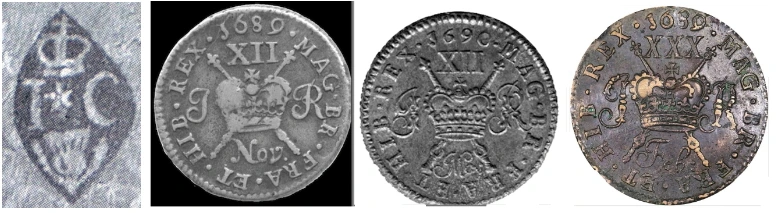
King James VII Coins (Grandfather of Bonnie Prince Charlie): In my search, I was unable to find any King James VII coins that included a crowned thistle bordered by two initials. I did locate several gun money coins produced by King James VII in 1689 and 1690 that included a crown and two initials, as shown below, but no thistle. Unlike the James VI/I coins, the crown is overlaid above two crossed scepters and between the initials, which are in script. This layout, a crown between two Latin initials, is another royal cypher that is different from all others. The coins below are the James VII coins that come the closest to matching to the Troon stamp, at least of all the James VII coins I viewed.
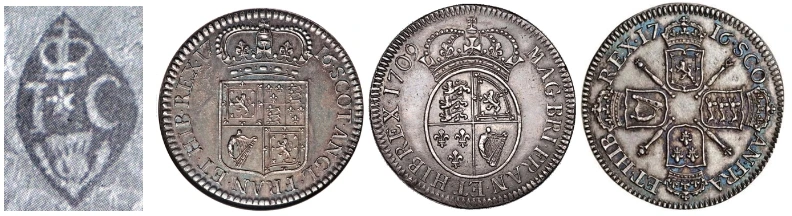
James VIII Coins (Ruling Authority 1701 - 1766 and Father of Bonnie Prince Charlie): In my coin search, I was unable to locate any coins produced by James VIII that included initials or a crowned thistle.2 Below are the James VIII coins I found that come the closest to matching the Troon stamp. Instead of his initials, James VIII used various versions of the Royal Arms of the United Kingdom under his crown, at least on the coins I located.
As demonstrated above, none of the royal insignia or cyphers are shared between monarchs. This is as expected, as royal insignia and cyphers are specifically designed to distinguish each monarch from all others. Furthermore, the crowned thistle bordered by two initials on the Troon clubs and the crowned thistle royal cypher on King James VI/I coins share a striking resemblance, and their similarities are clear. In contrast, when comparing the Troon stamp to the royal cyphers and insignia on the coins of later kings, the differences are far more apparent than the similarities.
On the Troon stamp, the second initial does not correspond to a traditional royal title. Therefore, in that one regard, it does not fit the strict definition of a royal cypher. However, if the second initial represents Prince Charles, then the stamp found on the Troon clubs is nothing less than a royal insignia, designed to distinguish two royals from all others. While rare, there are other ancient examples of two royal initials under a single crown.
Below are two coins that each bear the initials of two different monarchs. The coin to the left was minted between 1560-1565 and bears the initials “F” for King Francis and “M” for Queen Mary I. The other coin was minted between 1689-1694 and bears a “W” for King William II and “M” for Queen Mary II. Both sets of initials are in monogram form and located directly underneath a crown, in keeping with a royal cypher.
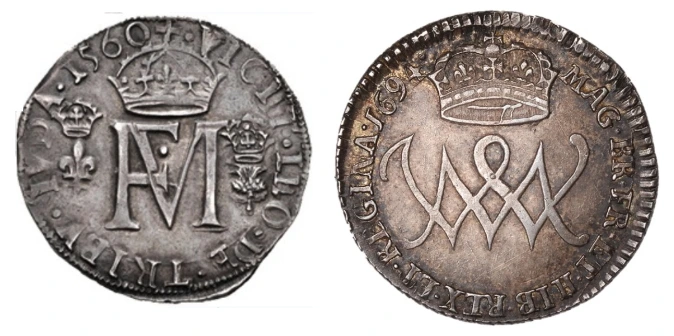
Neither of these coins include an “R”, but the two initials below a crown still function as a royal cypher and identify specific royals. In this case, they identify a king and queen who reigned together. Given this witness of history, if the “C” on the Troon stamp represents “Carolus” for Prince Charles—as its inclusion with the initial of a king next to a crowned thistle would indicate—then the marks on the Troon clubs are, indeed, royal insignia approved by the King. Which Charles does the C represent? That question is easy to answer.
Examining the royal insignia of their respective fathers provides an unequivocal answer, clearly identifying Prince Charles as the son of King James VI/I. If James VI/I aimed to emphasize a royal connection and establish his identity alongside his heir, there would be no better or more logical way to achieve this than by using a royal insignia modeled after his own, featuring a star to signify succession and the initial of his successor. In other words, if the letter "C" on the Troon stamp were an "R," then the marks on the Troon stamp, as crude as they are, would be widely accepted as the royal insignia of King James VI/I.
The stamp on the Troon clubs is clear. It is simple. It is thorough. And it is a close match to the royal insignia of King James VI/I in layout, style, and font. James VI/I’s “signature” is all over these clubs.
3.1b Vesica Piscis ↩
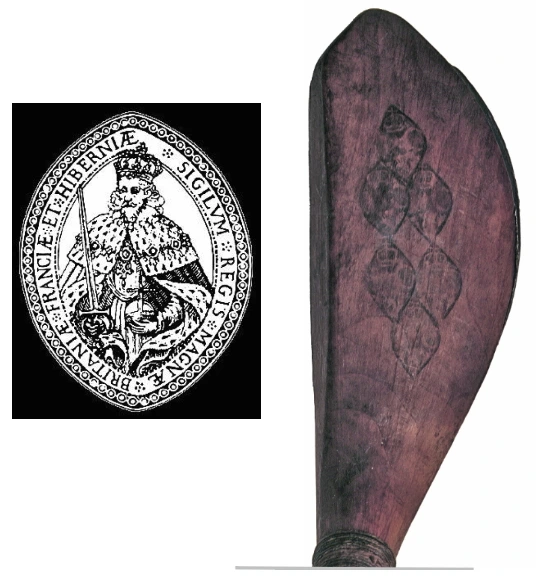
The vesica piscis used on the Troon clubs was used in Christian iconography for over a thousand years prior to the reign of James VI/I. It often frames images of Christ, the Virgin Mary, and other saints, symbolizing holiness and the intersection of heaven and earth. While the previous Stuart kings believed that the monarch was divinely ordained, it was James VI/I who claimed a divine right to rule and formalized the doctrine of the divine rights of kings. It was James VI/I who authored an extensive political treatise on the divine right of kings and their responsibility to God alone (The True Law of Free Monarchies and Basilikon Doron first published in 1598). It was James VI/I who commissioned and produced the King James Bible. It was James VI/I who sought to peacefully unite England and Scotland under Protestantism. Furthermore, as shown below, it was King James VI/I who actually created a coat of arms where his image is framed by a vesica piscis. He also included a crown and his “I” and “R” initials on the reverse side:
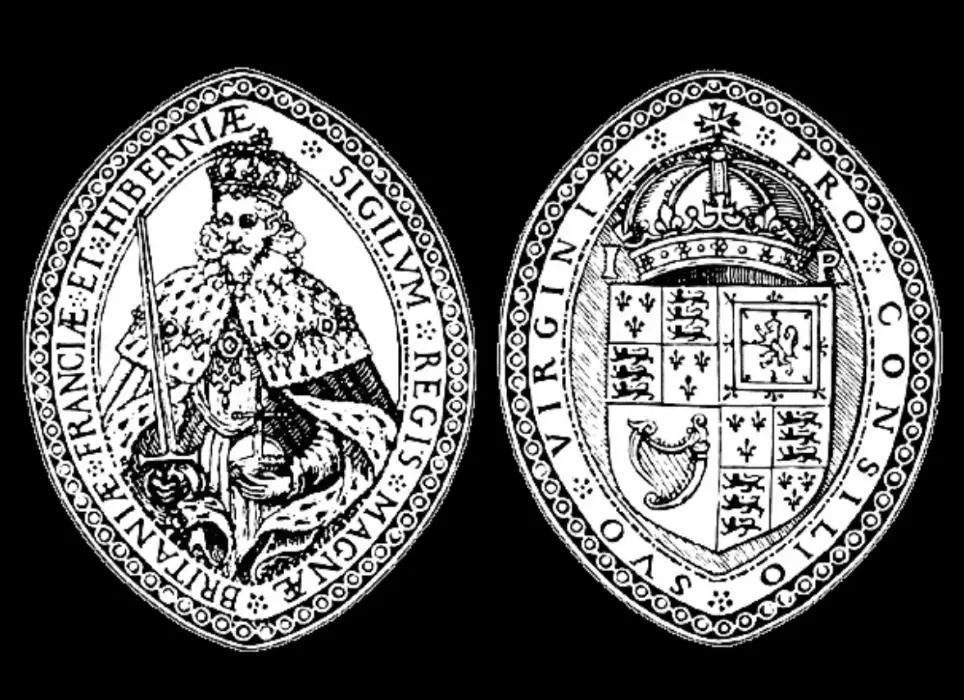
This coat of arms was created to serve as the seal for the Charter of the Virginia Company of London, established by royal charter of James VI/I on April 10, 1606, just three years after prince Charles was born. The purpose of the company was to establish colonial settlements in North America. It was responsible for establishing the Jamestown Settlement in 1607, the first permanent English settlement in the present United States.
The vesica piscis is not a traditional symbol in Scottish or English heraldry; it is not something that Scottish or English kings typically used to frame their insignia (I found only this instance). Instead, the vesica piscis is more closely associated with Christian iconography and medieval art, where it served primarily as a religious and spiritual symbol. Its presence around a royal insignia or coat of arms is highly unusual and likely intended to emphasize that James VI/I possessed a divine connection to God and sovereign authority.
As illustrated above and below, it was James VI/I who enclosed an image of himself, a crown, and his initials within a vesica piscis. As also shown below, the vesica piscis-shaped Troon stamp is impressed not once but six times on the top of each clubhead, and done in a manner so all six stamps together approximate a vesica piscis. Who would make such a bold declaration—repeating it so insistently—of personal identity and a divine connection with heaven? A humble clubmaker, or a king known to picture himself inside a vesica piscis? Is there any doubt left about who authorized the use of a vesica piscis to frame the royal insignia identifying two royals on the Troon stamp—an insignia that for all intents and purposes matches the royal insignia on various King James VI/I coins?
In early Christianity, before the Catholic and Orthodox churches formalized, the Vesica Piscis symbolized Christ and the concept of divine creation. The shape is often associated with the fish (a key Christian symbol meaning "Jesus Christ, Son of God, Savior"). The Vesica Piscis also represented the intersection of heaven and earth or the union of human and divine nature, central to Christian theology. Its association with the fish often led to its use as a discreet identifier for Christians during times of persecution.
The Vesica Piscis was not exclusively Catholic but was embraced as a broadly Christian symbol in the early centuries of the faith. Over time, its use became more prominent in Catholic and Orthodox traditions, especially in art and architecture. Other Christian groups, such as the Oriental Orthodox Churches and Gnostic sects, used it less frequently but still shared an appreciation for its symbolic and sacred geometry.
Its broad appeal lies in its universal symbolism—the merging of two worlds, heaven and earth—making it a powerful motif across different Christian traditions even before and beyond Catholicism. The fact that King James VI, a protestant, used it to enclose his own image and royal insignia is undeniable evidence that he embraced its broader Christian symbolism and did not view it as an exclusive Catholic symbol.
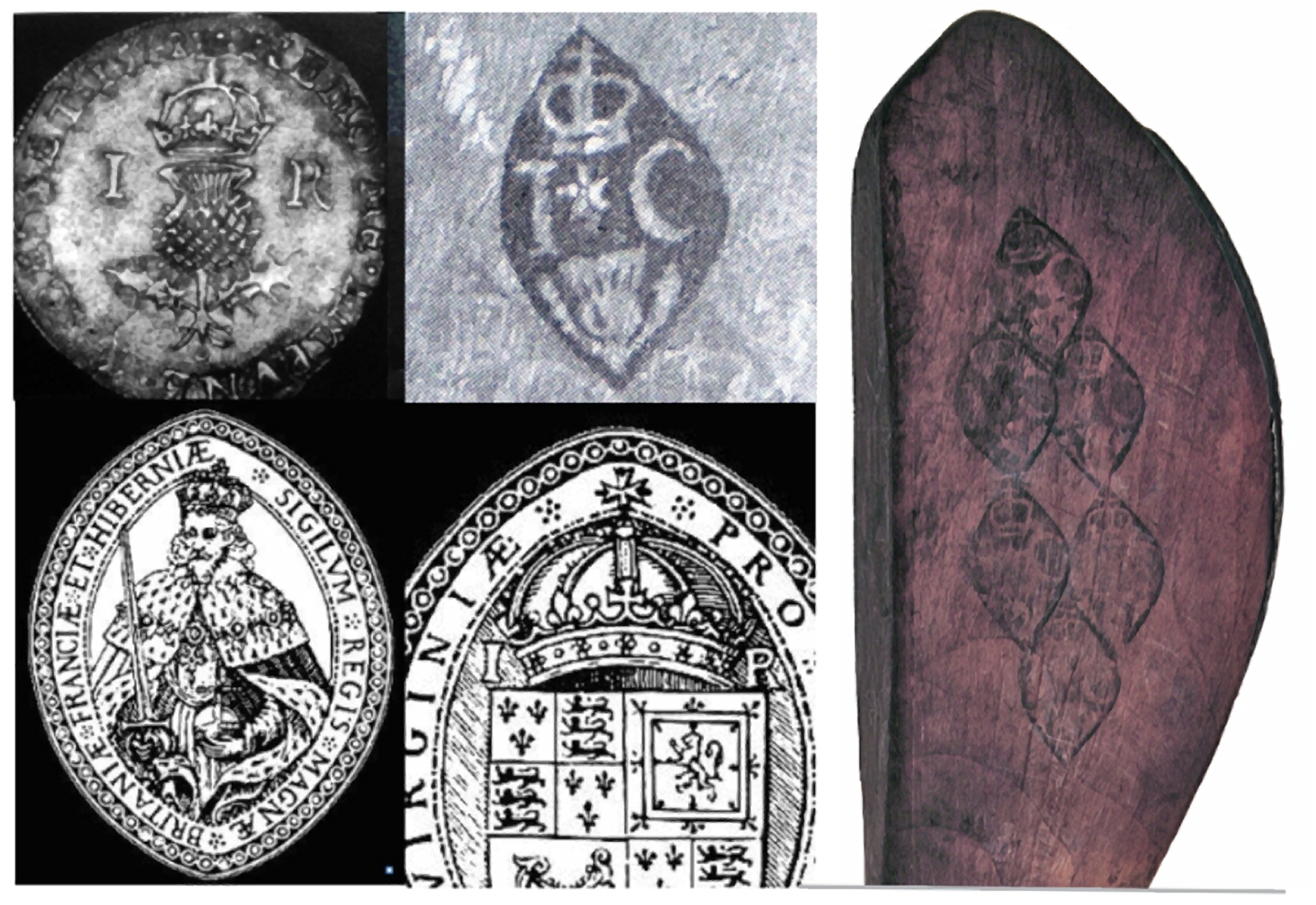
3.1cJames VI/I & James VIII Insignias ↩
The James VIII coins referenced earlier in Section 3.1a do not bear a royal cypher. However, James VIII did have his own insignia that featured a royal cypher. As shown below, this James VIII cypher is engraved on the oval center of a snuff mull gifted to Colonel Donald Murchison in 1715. The cypher consists of a unique crown, flanked by the letters "I" and "R," above a thistle. (More about the Jacobites and this snuff mull can be read here.)
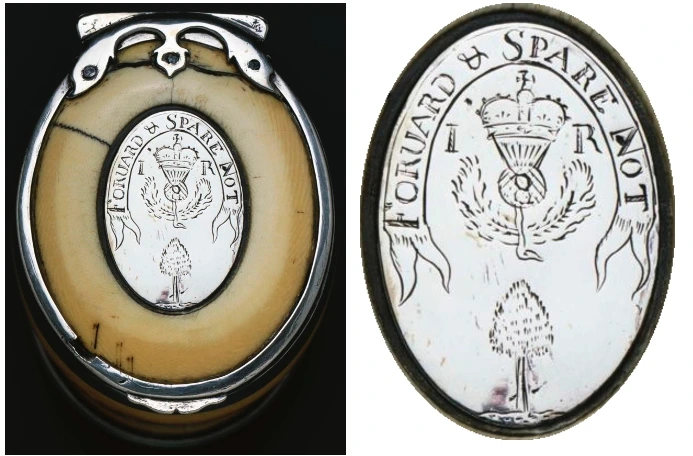
Like James VI/I before him, James VIII used a crowned thistle as part of his royal insignia. Additionally, the James VI/I coin features the same initials as those found on the James VIII insignia, but that is where the similarities end.
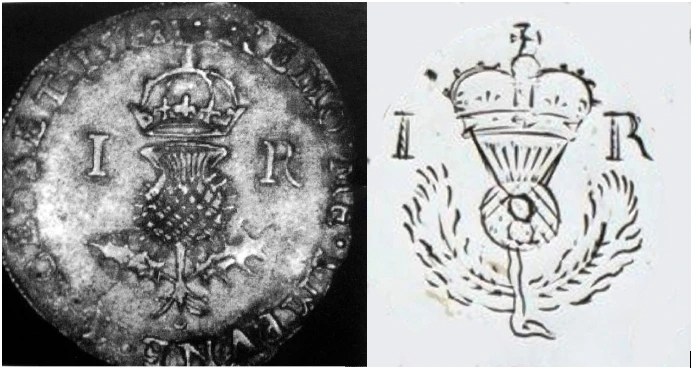
As shown above, the insignia in question are markedly different. The crown and thistle in the James VIII insignia come together to form a third heraldic symbol—a heart. This display of creative ingenuity sets the James VIII insignia apart from all others and uniquely identifies him as the monarch, though he was uncrowned. While heraldic designs often carry layered meanings, the combination of traditional Scottish symbols, such as the thistle, with the heart shape could symbolize the monarch’s dedication and loyalty to Scotland.
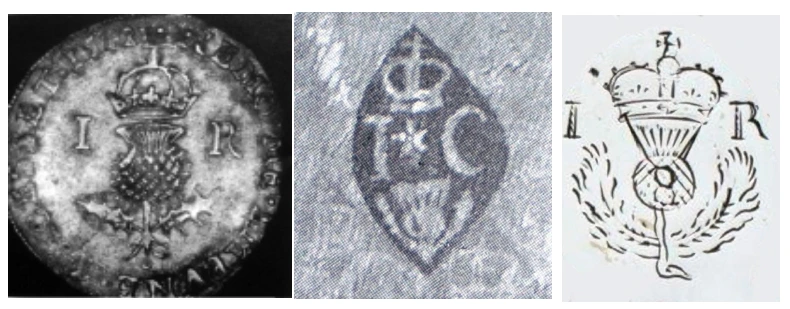
As shown above, only the James VIII insignia features a heart shape, while the Troon stamp insignia bears a much closer resemblance to the James VI/I design. Additionally, their basic royal cyphers—made up of the crowns and initials—are distinctly different. The crown in the James VIII cypher (modeled after the St. Edwards Crown) forms the top half of a heart, whereas the crowns on both the James VI/I coin and the Troon stamp (modeled after the Crown of Scotland) do not.
The comparison of these three royal insignia once again points directly to James VI/I as the monarch behind the Troon clubs.
Note that the small size and vesica piscis shape of the Troon stamp, along with the likelihood that it was crafted by a clubmaker, limit the degree of detail it can display. However, the significance of royal cyphers and insignia doesn’t rest in the small details—which can sometimes resemble those of other monarchs—but in their overall composition and design. It is the complete presentation that makes each one unique and identifiable as belonging to the monarch who created it. With royal cyphers and insignia, “some of the flowers might look similar, but the gardens are entirely different.”
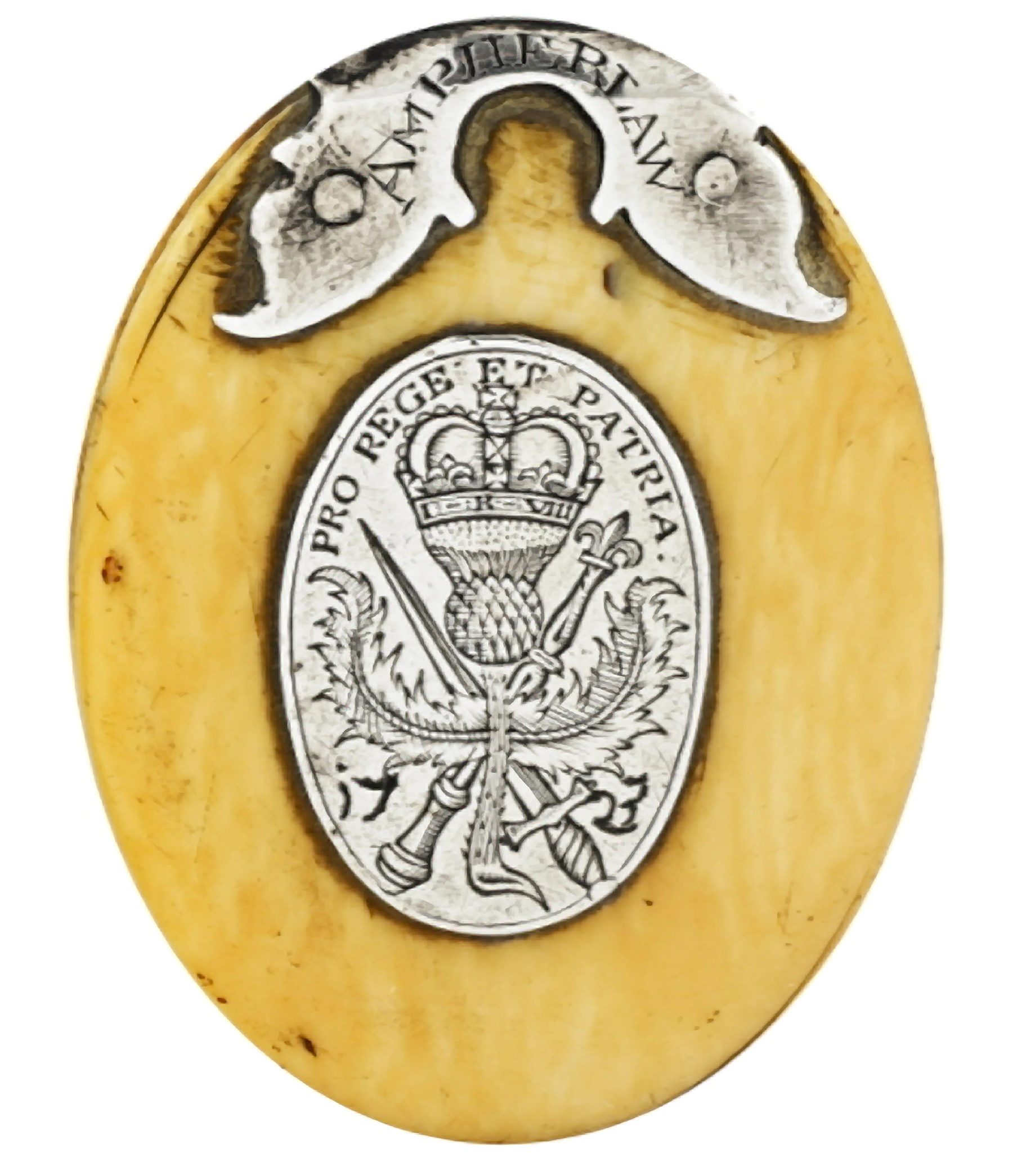
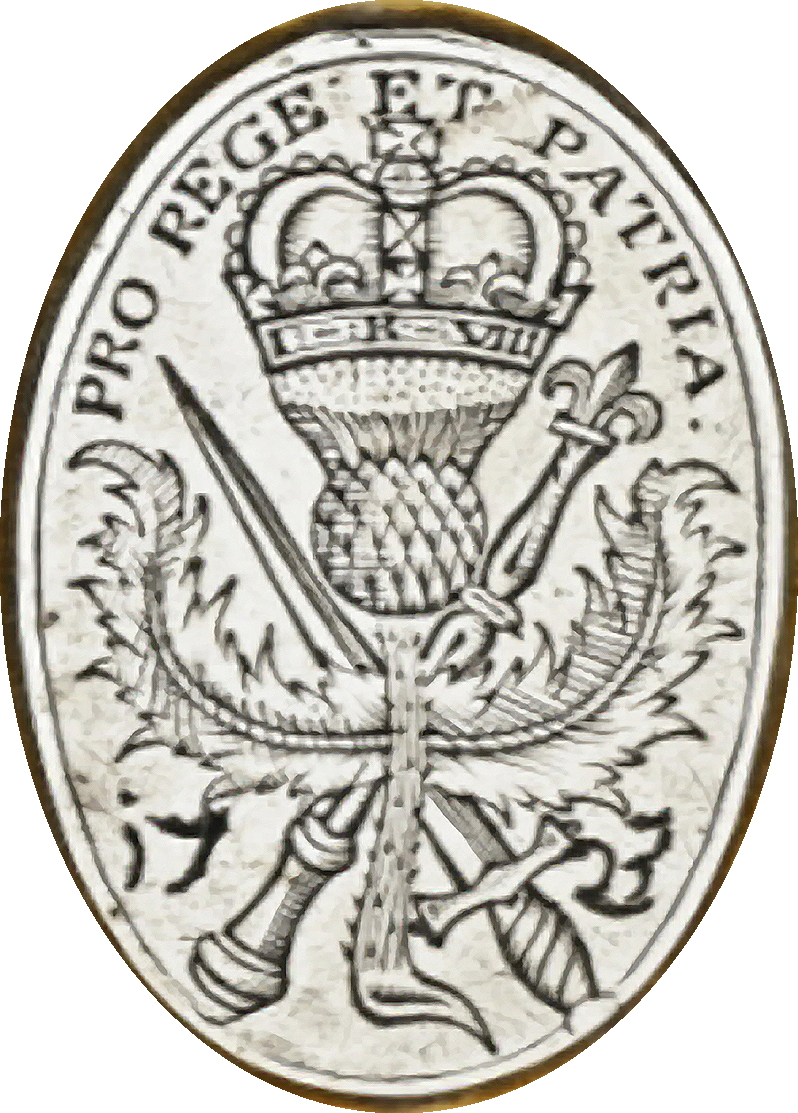
Below are images of another royal cypher of James VIII, featured on the top of a circa 1723 snuff mull sold by Bonhams in 2011. This cypher prominently displays "IR VIII" across the circlet (or base band) of the crown. It bears strong similarities to the previously shown James VIII cypher, as slight variations in a king’s cypher are quite typical. Nevertheless, a clear and undeniable connection exists between the two designs. Once again, this second cypher is distinctly different from the one found on the Troon clubs
3.1d The 1639 Visit of Charles I to Hull, England ↩
As Phillip Boulton documents in his December 2010 Through the Green “Maister House” article, King Charles I was in Hull, England, in 1639—twelve years into his reign. During this visit, Charles I attended a reception just 300 yards from the Maister house. William Maister, a prominent citizen of Hull who served as chamberlain in 1639, sheriff in 1645, and mayor in 1655, was likely present at the reception. This provides the simplest explanation of how the clubs might have made their way to Hull, England.
Recognizing King Charles I’s presence in Hull in 1639—and the possibility that William Maister attended the reception—is not to suggest that Charles I personally gave Maister the clubs at that time, nor does it explain how the Troon clubs ended up in the Maister house. Not at all. However, it does provide the simplest explanation for how the clubs made their way to Hull, where Maister lived and was well connected. How he came into possession of the clubs, or how they ultimately ended up in his house, remains unknown.
3.1e The Clubs Themselves and Others Stand as a Witness ↩
The Troon clubs, both woods and irons, stand as evidence of their connection to King James VI/I because they fit the time frame of his reign. As shown in The Oldest Iron, the Troon Clubs, and Early Club Evolution, their early 1600s date fits the evolution of both wood- and iron-head golf clubs.
The age of the Troon irons is corroborated by an 1891 Golf magazine article, which presents a square-toe heavy iron clubhead with a straight topline and sharp hosel crease as being made in 1682. The article features a detailed artist’s sketch of both a coin and the clubhead, both of which were recovered when a building in Leith, Scotland, was demolished. The coin's 1682 date and the building’s 1682 cornerstone date are linked with the clubhead. In contrast, the Troon irons, which have curved toplines, swept necks, and a spur toe on the heavier iron, clearly predate the square-toe irons with straight toplines and sharp blade creases (as outlined in section 1.3 and 1.4 of The Oldest Iron).
The age of the Troon woods is confirmed by the club the Duke of York gave to his young caddie, Andrew Dickson in 1682. Clubmaker Douglas McEwan’s account of this club can be found in Dr. McPherson’s 1891 book Golf and Golfers Past and Present, and the club is now part of Royal Musselburgh Golf Club’s collection. The Duke’s club features a less pointed and angled splay toe compared to the Troon clubs, indicating it was made after the Troon woods. It represents a transitional design between the sharply angled splay toes of earlier woods, like the Troon woods, and the round toes that became common in long nose woods by the early 1700s. Thus, the 1682 date attributed to the Duke of York's club by Douglas McEwan aligns perfectly with this evolution (see 2.2 and 2.4 in The Oldest Iron).
In summary, the stamp on the Troon clubs consists of several symbols, none of which are unique individually, as they have been in use for centuries and remain prominent today. To uncover the meaning behind the marks, no single element, fact, or detail can definitively reveal their origin. Instead, one must consider why these symbols were combined into a single stamp and how they relate to one another. It is the cumulative weight of all the evidence, grounded in the most plausible explanations, that brings the significance of the marks into focus.
The King James VI/I theory is based on the simplest and most straightforward explanations, fully incorporating all known facts with a high degree of probability. It accounts for and documents the royal insignia found on the Troon clubs and stands as the only theory that does not require dismissing, downplaying, or explaining away any documented statements made before 1900 about ancient clubs. Furthermore, it does not rely on silver trophies, many of which do not closely resemble clubs contemporary with their engraved dates. The strength of this theory lies in the verifiable evidence surrounding the Troon clubs and their royal insignia. For over 125 years, this evidence has been in plain sight, overwhelmingly pointing to James VI/I as the monarch behind their creation.
4.1 Theory 2: James VIII and Bonnie Prince Charlie ↩
The second theory identifies the clubs as made during or after 1720, when Bonnie Prince Charlie was born and James VIII was in exile. According to this theory, as it relates to the Troon stamp, the 'I' is the Latin initial of 'Iacobus' for James VIII, and 'C' is the Latin initial of 'Carolus' for Bonnie Prince Charlie. The heraldic star between the initials shows succession, and the vesica piscis symbolizes their belief in a divine right to the throne, following in the precedent set by James VI/I. By 1720, James VIII had been in exile for 38 years, so either he would have had to commission the clubs or a Jacobite supporter had them made to express loyalty to James and his heir. According to this theory, the clubs would have been made no later than 1741, as they were discovered over a century and a half later in a boarded-up closet along with a newspaper dated 1741.
4.1a The Evidence and Analysis ↩
The evidence used to support this second theory is grounded in three foundational elements. The first, as mentioned, is the fact that the Troon clubs were discovered in a boarded-up closet that included a newspaper dated 1741.
The second is the Honorable Company’s 1744 silver trophy club. This perpetual trophy is modeled after a club that has many of the characteristics of a Troon club, and its shape and form appear to be from the same general time frame. The Troon woods and the 1744 silver trophy club do look a lot alike, that is for sure.
The third element is based in the following statement:
“Before the mid 19th century (with very few exceptions) it was the custom to design and make items that were new, up to date and fashionable, even though some design elements included classic motifs. It is inconceivable, therefore, that before the mid 19th century any silver club would have been made to a past design.” (The Oldest Clubs, p. 189, Robert G. Gowland, 2011.)
If it truly is “inconceivable” that a silver trophy club produced before the mid 1800s would not be made to a prior design, then, indeed, the Troon clubs would date after 1720 and the initials they bear are those of James VIII and Bonnie Prince Charlie. End of discussion. Upon closer examination, however, it is not inconceivable.
It is a documented fact that, during the 1700s, the Royal Company of Archers in Edinburgh—a large number of whom were also members of the Honorable Company of Edinburgh Golfers—valued competing for antiques including an antique silver trophy arrow. In his book The History of the Royal Company of Archers, published in 1875, James Balfour Paul details a number of silver arrows made between 1603 and 1875 that were perpetual trophies, shot for by the Royal Company. When discussing the Peebles Silver Arrow, James Paul documents the desire of the Royal Company of Edinburgh Archers to use antique bows and arrows as prizes in the 1700s and to compete for a 123-year-old silver trophy arrow that reflected the antiquity of their sport:
“In 1784 Dr Spens presented an ancient bow and a pair of arrows, [italics mine] to be shot for on seven successive Saturdays . . . . But one of the most valuable and interesting prizes which the Company has ever shot for was brought under their notice during this year. At the dinner after the competition for the Edinburgh Arrow, Mr. Grieve, the Lord Provost of the city, and Mr. Alexander, the Provost of Peebles . . . were both admitted members of the Royal Company without payment of fees. The latter gentleman brought with him a silver arrow belonging to the town of which he was chief magistrate, and which bore medals dated so long ago as 1661. The Council [of the Company], it is stated, ‘desirous that so ancient a prize should be revived and shot for annually [italics mine], signified their wishes that Provost Alexander mention their inclinations to his brethren of the Town-council of Peebles with regard thereto, and inform [the Council] of their resolutions upon the matter.’ Meanwhile the arrow was left in the hands of the Treasurer of the Company; and the wishes of the Council, as we shall see, were afterwards complied with.”
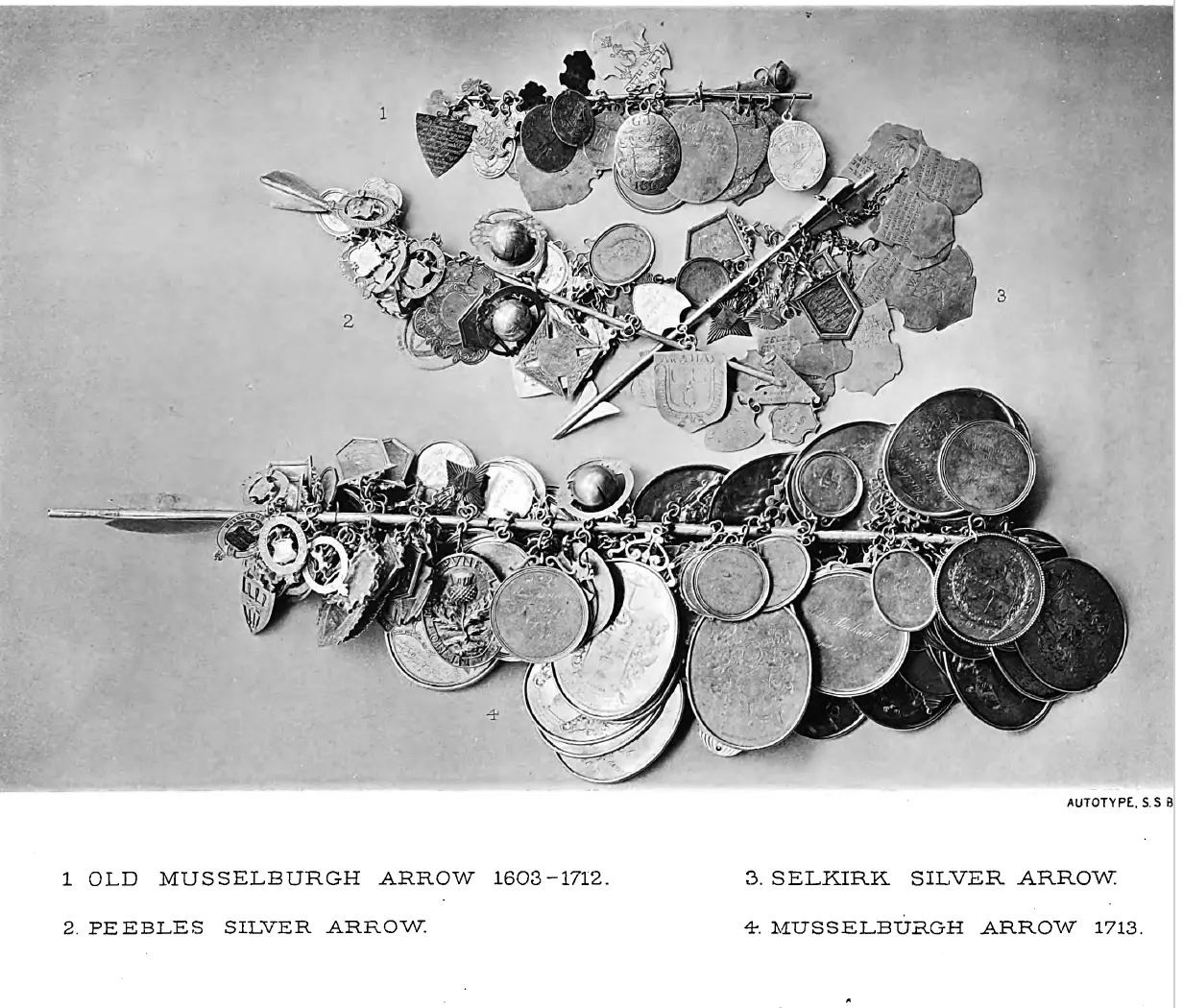
(Above are the ancient arrows shot for by the Royal Company of Archers in Edinburgh as shown in James Paul’s 1875 book.)
If the Royal Company so clearly desired to compete for an ancient silver arrow during the 1700s—and made a concerted effort to do so—it is eminently possible that its members who were also members of the Honorable Company would want to compete for a silver club that at least looked ancient.
Proof of this is found in five silver trophy clubs made across the next nearly 100 years after 1744. None of them are copies of the 1744 club or each other, but they all have splay/angled toes. Furthermore, these silver trophies appear to be modeled after clubs originally made with a round toe, not a splay toe, as documented in section 2.5 of The Oldest Iron. If the members of the additional golfing societies only wanted to compete for silver trophies that were modeled after the most up-to-date and fashionable clubs, why would they take a contemporary club and modify it with a splay toe when making a silver trophy club?
Moving beyond “inconceivable,” and in light of the above-cited evidence, I believe a more accurate statement would be: Given that members of various golfing societies desired to connect with and celebrate the ancient roots and past royal patrons of the game, it is entirely conceivable that 17th-century design elements, as used on the clubs of kings past, would be incorporated into 18th- and 19th-century silver trophy clubs.
Further demonstrating this desire to connect to the royal and ancient roots of the game, the Society of St. Andrews Golfers (who played for the 1754 and 1840 silver clubs) received permission from the British Monarch to change its name to the “Royal and Ancient Golf Club of St. Andrews” (itallics mine).
4.1b Five Additional Issues ↩
Below are five additional points that weigh against the theory that the clubs were made between 1720 and 1741.
-
The second theory disregards documented history, overlooking documented evidence about certain ancient golf clubs. If the Troon clubs date after 1720, the 1891 Golf article about the 1682 Iron found in Leith (see 1.4 The Oldest Iron) and the 1891 McEwan account of the 1682 Duke of York club (see 2.2 The Oldest Iron) would need to be dismissed as inaccurate or hearsay. The only way that can be done, however, is to rely on conjecture.
One might speculate that the iron head was crafted well after 1682 and that its discovery alongside a 1682 coin during the demolition of a building with a 1682 cornerstone was purely coincidental. But how likely is it that the reporter, editor, and everyone involved in the 1891 Golf magazine article got the facts wrong? What are the chances that they went to the trouble of featuring the 1682 coin alongside a detailed drawing of the iron head, reported them as being found together, and yet the connection is significantly off? While it's not impossible, the odds are slim that either alternative explanation is more accurate than the original report.
What evidence is there to cry hearsay or cast doubt on the Douglas McEwan account of the Duke of York gifting a club to a young Andrew Dickson in 1682? The club was in the possession of the McEwan family as part of their small collection of approximately nine clubs, five of which dated to 1800 or earlier as documented in the Oct. 9, 1896 issue of Golf. Furthermore, Douglas McEwan was recorded as showing the club to Dr. James McPherson who described the club and its history in his 1891 book Golf and Golfers Past and Present. The McEwan firm later displayed the club at the Glasgow International Exhibition of 1901 before gifting it to Royal Musselburgh, the golfing society that currently owns the club (it is pictured and presented in section 2.2 of The Oldest Iron). Who alive today knows more about antique golf clubs and Andrew Dickson than the McEwan family of 18th- and 19th-century clubmakers?
James McEwan worked just a few miles from John Dickson for 17 years before John’s death in 1787. If the Duke of York club came to the McEwan family through James or his son Peter, which makes the most sense given their close proximity to the Dickson family, what are the chances that they would forget the history of a club given by royalty to Andrew Dickson, whose legacy James and Peter understood far better than we do today? Anything is possible, but the chances that the McEwans who ate, drank, and slept clubmaking were mistaken or Dr. McPherson got things mixed up about a club once owned by James II before he became king are small.
-
The second theory neglects the evolution of golf clubs, disregarding what ancient golf clubs reveal about their history, as I have shown in my previous article. If long-nose woods did not gradually evolve from large to small, from splay toe to round toe, and ancient irons did not evolve from spur toes with swept necks to square toes with sharp blade creases and then to round toes, how did they evolve? With no rhyme or reason?
To claim that the Troon clubs were made after 1720 would require us to believe in a rapid and unprecedented "super cycle" of golf club evolution between the 1720s and 1770s. In this scenario, long-nose woods would have had to shrink dramatically, and irons would have gone through multiple design changes at a pace not seen in any other period of the wood-shaft era. Such a theory would also force us to dismiss the established accounts of the 1682 iron and the Duke of York's club, both of which place these types of clubs firmly in an earlier time.
The likelihood of such a 50-year super-cycle in golf club design is exceedingly low. A steady, more gradual evolution of clubs, as supported by historical evidence, makes far more sense than assuming such a rapid transformation took place, particularly when it would require dismissing well-documented historical accounts.
-
The second theory overlooks the 1639 visit of Charles I to Hull, where the clubs were found, in favor of the idea that a Jacobite intermediary knew the Bonnie Prince, received his clubs, and brought them to Hull after 1720. That is possible, but it is all speculation that brings up still more speculation of who, what, why, where, when, and how. Yes, the clubs were found with a newspaper dated 1741, but the chances are just as high that the Maister family would want to preserve the clubs if given to them by a king 100 years earlier. The 1741 newspaper does not verify when the clubs were made, it only identifies when they were stored.
Neither James VIII or Bonnie Prince Charlie visited Hull, England, Bonnie Prince Charlie spent only one month of his life in England and that was in 1745 as part of a Jacobite uprising. Given these facts, the chances are higher that the Troon clubs made it to Hull while in the possession of Charles I, as discussed earlier, and not Bonnie Prince Charlie.
- The second theory overlooks the significance of the combined marks—the royal insignia—on the Troon clubs, which are a valid match to the royal insignia found on the King James VI/I coins shown earlier. To connect the Troon stamp to James VIII—despite the completely different insignia he used—one would have to downplay or dismiss the tradition of monarchs using distinct insignia and cyphers. Alternatively, one would need to assert that the Troon stamp is entirely unrelated to the King James VI/I insignia, attributing their similarities to random chance. Neither option holds any credibility or substance.
- The alternate idea that an elaborate stamp identifying James VIII and Bonnie Prince Charlie was created by a clubmaker or Jacobite supporter during the Jacobite era to express allegiance to the deposed king holds a low probability, primarily due to the necessity for secrecy among Jacobites and their sympathizers. Openly displaying loyalty to the Jacobite cause was considered treasonous in both England and Scotland. In contrast, during the reign of James VI/I, there were no Jacobites, eliminating any concerns that the insignia on the Troon clubs could implicate anyone as disloyal. These facts suggest that it is far more likely the Troon stamp dates back to a time when openly displaying the insignia of a Scottish king posed no risk of persecution.
In summary, the foundational evidence that the Troon clubs date after 1720 and attach to James VIII/Bonnie Prince Charlie does not hold up. The silver trophies used to date the Troon clubs after 1720 are not accurate models of the clubs in use when the trophies were made, and there is clear evidence that the oldest silver trophy clubs were constructed to look like clubs long out of fashion. Also, the 1741 date on the newspaper found with the Troon clubs tells us only when the King’s clubs were stored, not when they were made. Given the many issues with this theory and its flawed foundational evidence, the chances are slim to none that James VIII (or anybody else alive after 1720) was behind the production of these clubs.
5.1 Theory 3: James Carstairs ↩
This theory promotes the idea the clubs were made by James Carstairs, clubmaker to King Charles II sometime between 1660 and 1685. It is not known if Carstairs was clubmaker to Charles II during all those years, but it is documented that he was for some of them.
The evidence supporting this theory hinges on the initials "I" and "C" on the club, which are suggested to represent James Carstairs, with the crown indicating he worked for the king. However, there is no other substantial evidence connecting James Carstairs to the Troon clubs beyond this assumption. In contrast, there is considerable evidence that contradicts this theory and tells us it is incorrect.
The crown and two initials stamped on the Troon clubs are laid out like a royal cypher. This is highly problematic for the Carstairs theory. A royal cypher is a direct symbol of the monarch’s authority, and even slight modifications to its layout, such as replacing a letter, would likely have been seen as a misuse of royal symbols. The cypher represented the monarch’s identity and was used on official documents, coins, and other items directly connected to the crown.
Yes, Carstairs had a royal appointment to serve as the king’s clubmaker, but even craftsmen appointed by the king—such as royal goldsmiths, silversmiths, or other royal artisans—had to follow strict protocols for identifying their work. They could be authorized to use specific marks or symbols granted by the crown, but these marks were distinct from the king’s cypher and insignia.
For example, a royal-appointed craftsman might be allowed to stamp their work with a crown symbol or a mark indicating royal patronage, but this would not resemble a royal cypher. In 1901, Robert Forgan became clubmaker to King Edward VII and was allowed to stamp a crown on his clubs but not a royal cypher. Instead, he put his name above the crown. Same with A.H. Scott, when he was named clubmaker to King George V in 1908. When Forgan received a royal warrant to be the clubmaker to the Prince of Wales in 1863, he was allowed to mark his clubs with the Prince of Wales plume to show his royal appointment. Again, Forgan put his own name above the plume, and on a few of his earliest authorized clubs included the words “Clubmaker to H.R.H. The Prince of Wales,” as shown below.
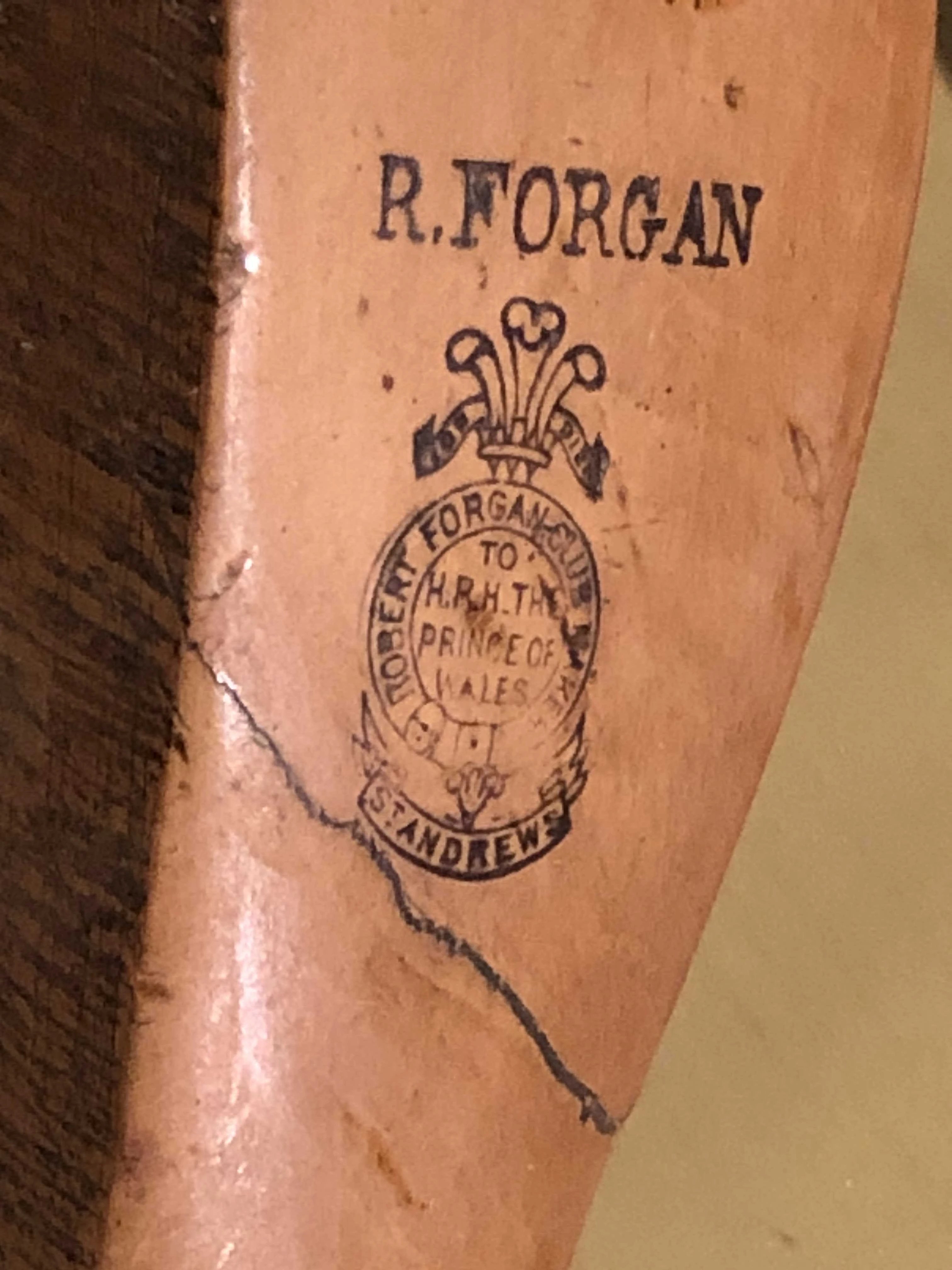
If Carstairs made the Troon clubs, he could have used a crown, but beyond that, it makes far more sense for him to stamp his clubs with his own initials in a much different location. Again, to mimic a royal cypher was to infringe on the King’s personal monogram.
The chances are extremely low that Carstairs used a stamp modeled after a royal cypher, let alone royal insignia that matches up far better to the royal insignia used by King James VI/I and not Charles II. In addition, there is no clear reason for Carstairs to craft a stamp that included a heraldic star and a vesica piscis. There are, however, plenty of good reasons for a servant of the crown not to use a stamp that looked anything like the stamp on the Troon clubs.
Although I am not an expert on Scottish and British heraldry and iconography, from everything I have read, it would be exceedingly rare for a non-royal to be permitted to place their initials beneath a crown in a layout that mimics a royal cypher, especially in the style of a royal insignia of an earlier king. Not only that, but to then enclose it in a vesica piscis to show the clubmaker had a divine right or special connection to God? As I see it, the likelihood of the Carstairs theory accurately identifying the man behind the mark is minimal.
6.1 Conclusion ↩
In this article, I have explored the three prevailing theories regarding the origin of the Troon clubs, each offering different timelines and explanations for their creation. The evidence overwhelmingly supports the first theory: the clubs were made sometime between the birth of Prince Charles in 1600 and the death of James VI/I in 1625. The elements of the stamp, including the “I” for James, a star representing succession, and the “C” for Charles, alongside other symbols of royalty, clearly point to a connection with James VI/I. These symbols are laid out in a manner consistent with an insignia of James VI/I and no one else, as confirmed by coinage of the period.
In addition, it was James VI/I who used a vesica piscis, like the one stamped all over the Troon clubs, to frame himself and his insignia on a coat of arms for a company he formed under a royal charter in 1606. However, the vesica piscis-shaped Troon stamp is impressed not once but six times on the top of each clubhead, and done in a way so all six stamps/insignias together approximate a vesica piscis. Who would make such a bold declaration—repeating it so deliberately—of personal identity and a heavenly connection? A humble clubmaker, or a king who framed himself within a vesica piscis to signify his divine right and sovereign authority to reign? The answer is obvious. The Troon stamp in its entirety would have been recognized and understood by James VI/I’s Scottish subjects.
Beyond the insignia on the clubs, there is also the documented 1639 visit of King Charles to Hull, England, where he attended a reception just 300 yards from the house where the clubs were discovered. Moreover, the age of the clubs is supported by two 1891 accounts that present both an ancient wood and iron that, while clearly newer than the Troon woods and irons, are dated no later than 1682. The facts all fit together and the puzzle has been solved, leading to an unmistakable conclusion:
James VI/I is the monarch behind the Troon clubs—Scotland’s most royal and ancient golf treasure.
—Afterword ↩
As the result of my research, I offer straightforward, what I believe are well-reasoned explanations for all six elements that make up the Troon stamp, none of which feel forced or speculative especially when the stamp is considered in its entirety, as a single insignia. However, as I am not a lifelong scholar of heraldry, I recognize there may be nuances beyond my knowledge. It's possible, for instance, that the vesica piscis was simply an incidental shape chosen by the clubmaker or that the star between the initials served merely as a placeholder to keep the layout from looking like it was modeled after a King James VI/I cypher. Some may interpret the stamp's lack of refinement as insufficient to signify royal ownership. Others might look no further than the initials “IC” and summarily define the clubs as the work of James Carstairs.
I welcome others to draw their own conclusions if they feel mine lacks merit. Yet, I would simply remind all that a compelling analysis is often one where each detail contributes to the whole, rather than dismissing elements as coincidental. With that said, if King James VI/I had indeed commissioned a set of clubs for Prince Charles—or for their shared use—and requested that they be marked with an insignia to identify both of them, I can hardly imagine a stamp more fitting to symbolize their royal connection, their bond as king and successor, and their “divine right to rule” connection with God which they proclaimed as fundamental to their authority as monarchs.
—Addendum #1↩
In 17th and 18th century Scotland, there were various types of insignia, not just royal insignia. The right to have a personal or family insignia, such as a coat of arms, was typically reserved for nobility, landowners, and those who were granted such rights. However, with the proper legal approval, individuals of significance outside the noble class—such as wealthy merchants or officials—could also acquire the right to use an insignia.
Personal insignia, whether they included crowned thistles or coats of arms, did not require the king's approval. These insignias were regulated by the Lord Lyon King of Arms, who ensured that each was unique and adhered to heraldic rules.
Royal insignia, however, required the monarch’s approval. Only the king had the authority to grant permission for the use of his royal insignia or cypher, including its overall design and distinctive elements. While common symbols like crowns or thistles were often used across different insignias, the specific way these symbols were combined and styled in royal insignias was unique. Copying a royal cypher or insignia would have been seen as an attempt to mimic or falsely claim royal status. In Scotland, the Lord Lyon King of Arms ensured that no two cyphers or insignias were identical or overly similar in their arrangement and design. Changing only the initials on a king’s cypher while copying/duplicating the rest of the insignia would not have been acceptable or approved by heraldic authorities. Only the monarch could alter the initials on his own insignia, and he did not require anyone’s approval to do so.
All insignia were designed to be unique, serving to identify a specific person, group, or organization. It’s not just the individual symbols that matter; it’s the unified symbol they form together. Stars, crowns, initials, thistles, and various combinations of these elements have been used for centuries, but the exact combination of these elements as found on the Troon stamp is not found anywhere else in the world. It exists solely on the Troon clubs. Every heraldic element in the Troon insignia was deliberately chosen and combined for the purpose of identification.
It is the entire insignia of the King James VI/I coin that corresponds with the entire Troon stamp. The slight differences between the two is accounted for by the star, which indicates why a “C” appears on the Troon stamp instead of an “R.” Even with these minor variations the overall appearance and presentation of the insignia is maintained, and that is important.
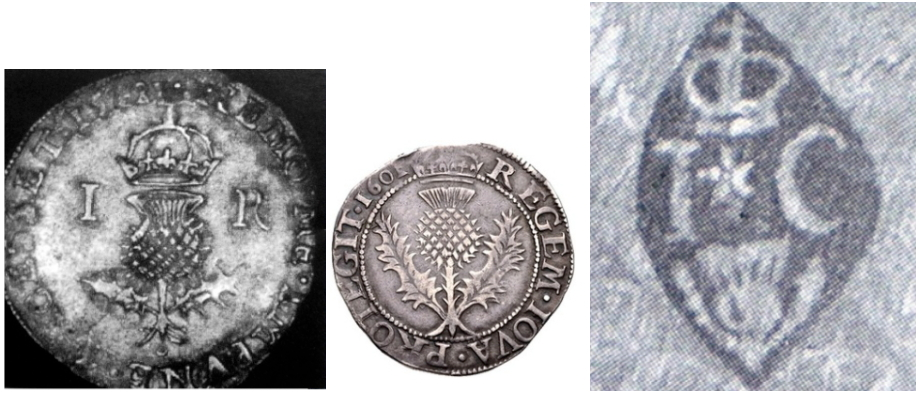
The flaw of comparing individual elements is evident in the image above, the thistle leaves on the left coin are shorter and positioned at a different angle compared to those on the stamp to the right. Concluding that these insignias represent different individuals based solely on these two elements would be misleading, as demonstrated by the coin in the center.
Like the 1582 coin on the left, the coin in the center was also produced by King James VI/I. However, the thistle leaves on this coin, minted between 1601 and 1604, are long and angled upwards, resembling those on the Troon stamp. Therefore, the slight difference in the leaves between the 1582 coin and the Troon stamp, crafted after 1602, is inconsequential, illustrating that different versions of an insignia can still represent the same monarch. Again, this is why the overall unified symbol of the insignia, its general appearance and presentation, is key.
Royal cyphers and insignias belonging to a single king could undergo subtle yet significant changes for various political and economic reasons, as seen in the coins produced by different monarchs throughout their reigns. Additionally, the monarch’s artistic preferences and practical considerations—such as space limitations or the nature of the stamp used to imprint the insignia—also influenced these modifications.
To the last point above, consider the Troon stamp. Given its small size and that it was likely carved in wood by the clubmaker, it is not a study in precision. The star in the center is not centered, the thistle leans slightly to the left, and the top of the crown is lopsided and tilts to the right. The “C” takes up more space to the right of center than the “I” does to the left of center. Consequently, the vesica piscis needs to be wider on the right-hand side than it is on the left-hand side, which, unlike the right-hand side, forms a perfectly symmetrical arc. Despite all these anomalies, the overall insignia—the unified symbol—clearly connects to other James VI/I insignia.
The vesica piscis used to frame the insignia also connects to James VI/I. It is a Christian symbol that James VI/I embraced and was known to use to identify himself. In tandem with his royal insignia, both serve to identify the king behind the clubs.
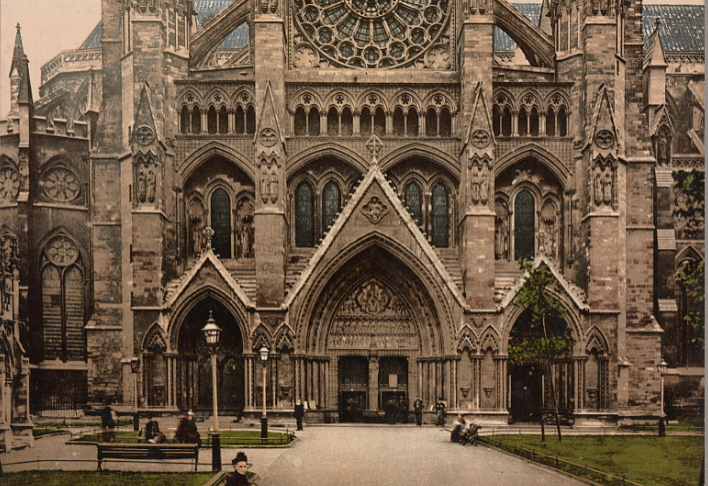
The architecture of Westminster Abbey, where James IV was crowned in 1603 and buried in 1625, makes good use of the vesica piscis.
—Addendum #2↩
The August 26, 1898 issue of Golf, reprinting an article from The Times, describes the two letters as an “I” and “C”: “In the upper angle there is a Royal crown, in the lower a Scotch thistle, in the middle between those emblems a five-rayed star, on the left-hand side of the star the letter I (which may stand for J), and on the right-hand side of the star the letter C.”
There has been recent commentary suggesting that the “I” on the stamp is actually a “J.” However, this claim lacks any supporting evidence. A quick review of the 1682 publication of The Scots Laws and Acts of Parliament shows both capital letters “I” and “J” in use. On one of the first pages, shown below, the word “MAJESTIES” is printed in capital letters using a font similar to what was used in “PARLIAMENT.” This font clearly approximates if not matches the “I” and “R” seen on the King James VI coins and aligns with the lettering on the Troon stamp. When comparing the “I” and “J” from “MAJESTIES” and the “I” in “PARLIMENT” to the first letter of the Troon stamp, it becomes clear that the first letter of the Troon stamp looks like an “I,” not a “J.”
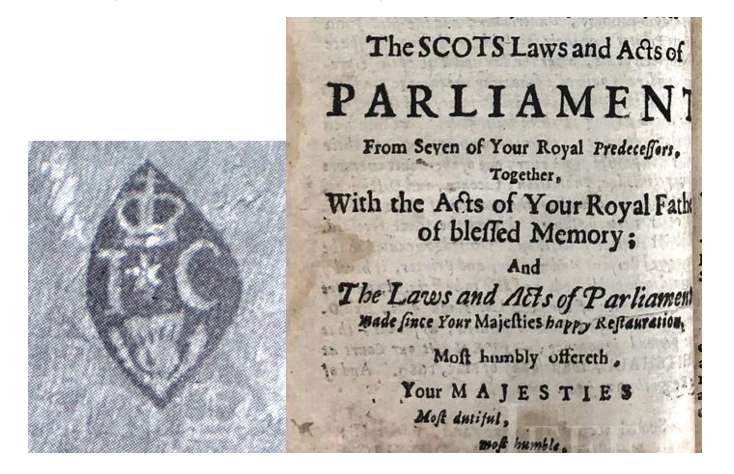
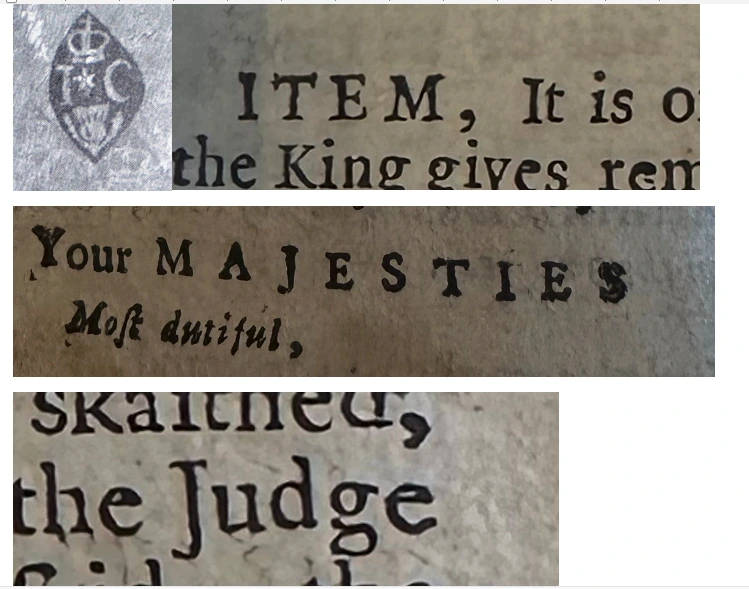
Below are close-up comparisons of the capital letters “J” and “I” from the 1682 Scots Laws and Acts, alongside the Troon stamp. If someone is determined to see what they want, they could interpret the “I” as a “J” and even imagine the star in the center as a crescent moon with three rays of light to its left! However, the straightforward and logical conclusion, without such imaginative leaps, is this: The first letter in the Troon stamp is not a “J.” It looks most like all the capital “I”s in the 1682 literature shown, as demonstrated in the examples provided below.
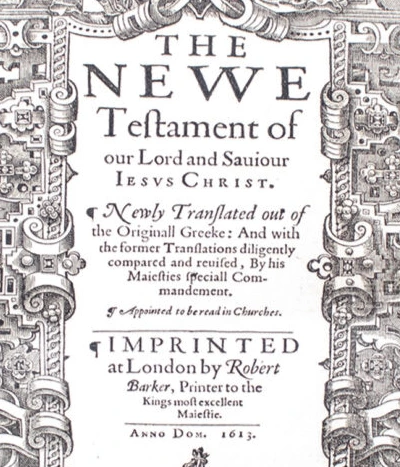
In the 1613 edition of the King James Bible as shown below, “JESUS CHRIST” on the title page is in capital letters, but the letter J in JESUS is rendered as an I no different than the I in CHRIST. Again, the font appears to be quite similar to if not the same as is found on the King James VI coins about to be presented.
The key point is that the first letter on the Troon stamp looks like the capital letter “I” as it was formally used on at least two major documents printed during the 1600s, and no doubt many more. It seems that this was well understood by the educated and observant men who examined the Troon clubs when they were first discovered, when the stamps were not doubt a little more readable (less faint) than they are today, and reported that the clubs were stamped with an “I” and “C,” not a “J” and “C.”
FOOTNOTES
-
A royal cypher is a unified symbol where the crown, initials, and any additional elements are combined into a single monogram or design, rather than being placed separately, such as on opposite sides of a coin. Royal cyphers can vary in format and may include initials, numerals, or other symbols, but they all serve the same purpose: to represent and identify the reigning monarch. The inclusion of a thistle or other heraldic elements beneath or around the cypher is typically considered part of a broader royal insignia, rather than a direct element of the cypher itself. When symbols like the thistle, crest, or other decorative components are added, they create a more complex design known as a royal insignia, which encompasses both the cypher and related heraldic elements.
A crown over a thistle, or a crowned thistle, without initials on either side is not a royal cypher but rather an emblem of Scotland that has been widely used by the public for centuries. However, when a crowned thistle appears on the coin of a king, it is reshaped and reformed to be different from all others, becoming an integral part of that king's royal insignia and identity.
Return ↩ - The dies for these coins were prepared by James VIII in anticipation of his restoration to the throne. However, since that did not happen, the coins were not struck until the early 1800s, long after his death. Return ↩